
PRICE WHEN REVIEWED
£639 inc VAT
SAMSUNG GALAXY S7 EDGE REVIEW
Samsung has now played around with a few curved screen smartphone and what felt like a bit of a gimmick is now a legitimate technology. Although the Galaxy S6 was the best phone of 2015, it was missing key features like expandable storage and waterproofing. Those are now back and the dual edge screen has more functionality so the Galaxy S7 edge is a serious contender for best phone of 2016. Here's our full and in-depth Samsung Galaxy S7 edge review.
See also: The 20 best phones 2016.
The Galaxy S7 and S7 edge are two of the first flagship phones we've reviewed this year so it's just the beginning in the fight for best phone 2016. However, it's so far so good for the Galaxy S7 edge which is an improvement on its predecessors – the Galaxy S6 edge and Galaxy S6 edge+.
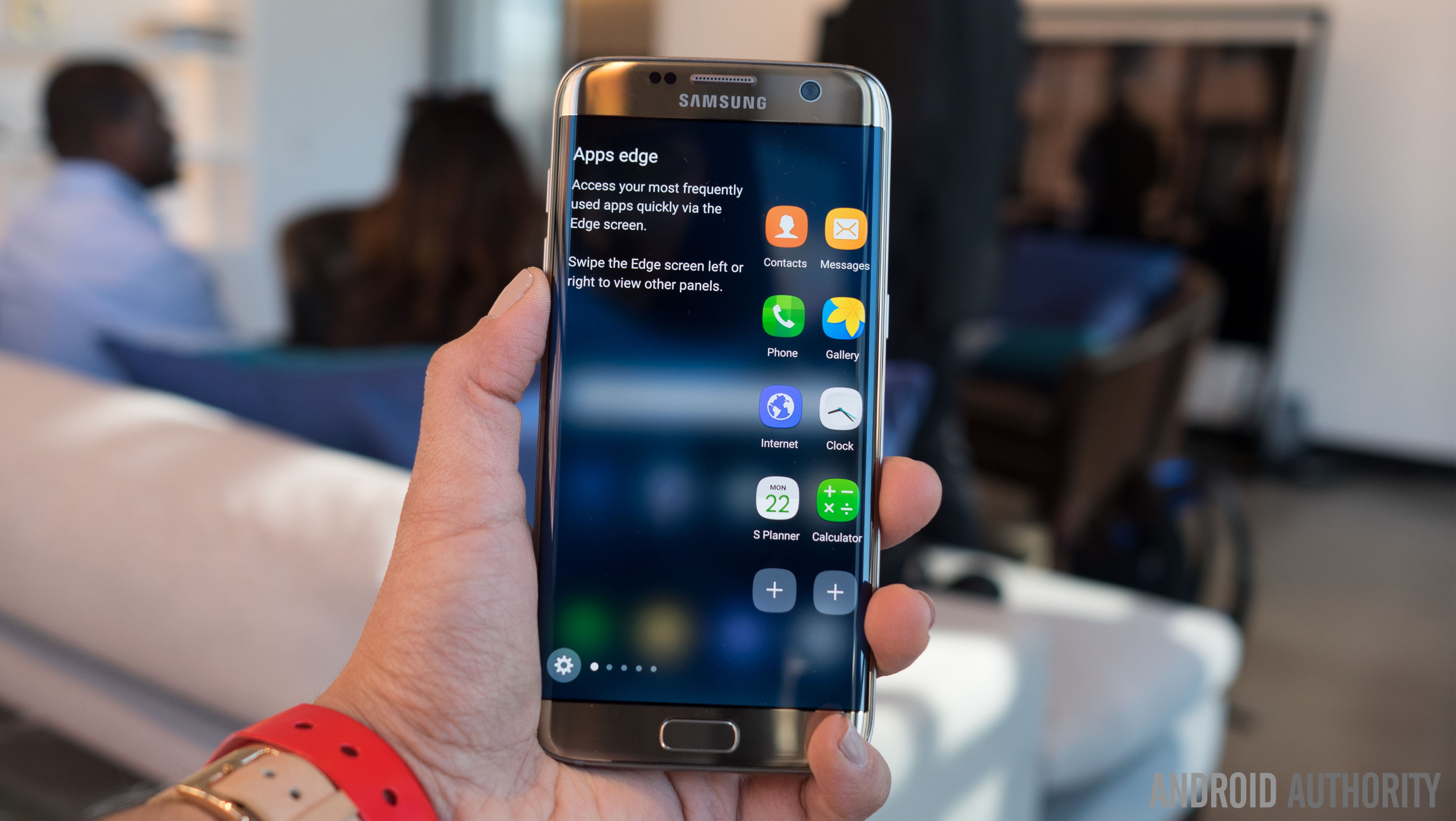
Samsung has settled on a single size for the Galaxy S7 edge and the phone looks dramatically stunning with its dual edge screen design. Once again, there's a combination of metal and glass which looks sleek and premium but also feels slippery and gets grubby a bit too easy. Although it looks similar, it's now fully waterproof without the faff of things like port covers.
Another major feature has been returned so fans will rejoice at the inclusion of expandable storage through the Micro-SD card slot. That's two out of three and although the battery is still not removable, it is bigger. A larger battery cell means longer battery life and we really don't mind that the phone is a bit thicker to enable this (and make the camera bump smaller).
Helping out with battery life, according to Samsung, is a new processor and although we expected the Qualcomm Snapdragon 820 model in the UK we've actually got the Exynos 8890 chip. There's a whopping 4GB of RAM and the Galaxy S7 edge breezed through ourbenchmark tests setting some new records.
fingerprint scanner and heart rate monitor, but the IR blaster has been dropped which will be a shame for some. A bigger deal is being made around the camera which has fewer pixels than the Galaxy S6 at 12Mp but Samsung touts amazing low light performance with the f/1.7 aperture and 'Dual Pixel' technology. We're really impressed with the camera and although it's one of the best on a phone, it's perhaps not as good in the dark as Samsung makes out.Also see: Best MiFi 2016.
A feature which isn't as big as we thought is the 'Always On' screen which is simply a software feature which shows some basic information on the display to avoid you unlocking the phone. It's handy but doesn't do as much as we thought and there's a small amount of control over it. That said, there are plenty of cool features hidden away in the settings which you'll want to explore including some existing ones like Smart Stay.
You can read our full and in-depth Samsung Galaxy S7 review.
The Game Launcher is one software feature which helps you be a better player by doing things like blocking notifications, lowering the framerate to save power and record the screen while you play. It's the dual edge screen which makes the Galaxy S7 edge stand out and the key difference when compared to the regular model. It's still a luxury but Samsung has refined and improved what it can do with new edge panels and greater control.
That's an overview of the Galaxy S7 edge but we're going to go into a lot more detail below. Use the links below to help you navigate to the different sections of the review.
Design and build | Hardware and specs | Dual edge screen | Always on display | Processor, memory and benchmarks | Storage and Micro-SD | Fingerprint scanner | Connectivity and sensors | Battery life and charging | Cameras | Software and apps
SAMSUNG GALAXY S7 EDGE REVIEW: PRICE AND RIVALS
Priced at £639 from the official Samsung store, the Galaxy S7 edge is one of the most expensive smartphone on the market (short of luxury ones from the likes of Vertu). If you're contemplating buying it over the regular S7, it will cost you an extra £70 which isn't much of a premium to gain the dual edge display.
In terms of competition, the Sony Xperia Z5 Premium is the closest on price at £599 from Sony's online shop. That phone is also a rival on the size, as is the iPhone 6S Plus which is cheaper for the equivalent model at £619 but goes all the way up to £789 if you want 128GB of storage.
Other key Android rivals to the Galaxy S7 edge include the LG G5 which is priced at £529 and the Google Nexus 6P which is just £449, so there are cheaper options if your budget is more limited.

SAMSUNG GALAXY S7 EDGE REVIEW: DESIGN AND BUILD QUALITY
Over the years, the Samsung Galaxy S range has developed and changed quite a bit, with each flagship offering a different design to its predecessor – quite recognisably so. However, that seems to have changed with the Samsung Galaxy S7 edge, which looks a lot like the S6 edge with its curved edge display and body comprised of a gorgeous combination of glass and metal.
While some may feel cheated, we're pretty happy that Samsung decided to stick with a design that made the Galaxy S6 and S6 Edge two of the most desirable phones of 2015. You can hardly blame the firm for not fixing something which wasn't broken.
One big change is that the S7 edge is bigger than its predecessor. Instead of offering two different sizes of the phone, Samsung has decided to make the S7 edge the larger option out of the two S7 phones. To this end, it's 5.5in in screen size which is slightly smaller than the 5.7in wielding S6 edge+.
Despite this move, the S7 edge doesn't feel like a huge phone. An impressive 76 percent screen-to-body ratio means that it's actually only marginally bigger than the regular S7 – we're talking 2mm wider and 8mm taller.
At 7.8mm (Samsung says 7.7mm), the Galaxy S7 edge is a little thicker than the S6 edge which means two things. The first is that the camera bump is a lot smaller, 0.5mm, which is nice and there's also room for a bigger battery – although it's still not removable. We'll talk aboutbattery life later on in the review, but for now we applaud Samsung for providing this rather than trying to simply make a thinner phone for the sake of the numbers.
In terms of placement, everything is where it was before (buttons, ports and slots). You might notice that Samsung has stuck with a Micro-USB port instead of moving to USB Type-C (we'll talk about this more in the hardware section). However, what you can't see from the outside is the resurgence of the Micro-SD card slot, which is combined with the SIM-card in one tray. It's a big advantage over the iPhone and some Android rivals, too.


ليست هناك تعليقات:
إرسال تعليق